What the best website for a salon actually does
A salon website has an unusually short job. Somebody is deciding where to have their hair or nails done, and they are looking for one person on your page whose hair looks like the hair they want. If they find it, they look for the price and the next free slot. If they do not, they leave.
Everything below follows from that, including the parts most salon websites get wrong.
The gallery is the site
Photographs of real work, at a size worth looking at, are not a section of a salon website. They are the argument. Three phone snapshots in a carousel lose to a competitor with twelve properly lit ones, and stock images of a woman having her hair washed lose to both.
Shoot in the salon, in daylight if you can, and shoot the back of the head as well as the front, which is what a client actually cannot see and most wants to. Caption the work with what it was: balayage on dark hair, a dry cut on a fringe, a full head of foils. Those captions are also the words people search for.
Publish the price list
Price on request costs you the booking. A client comparing two salons will book the one that told them, and the one that did not will never know it lost.
List prices per service, and say what changes them: length, thickness, whether a colour correction is needed, whether a consultation is required first. If your stylists are on different price tiers, publish the tiers. It sets the expectation before the client is in the chair, which is where an awkward conversation about money is worst for both of you.
Booking has to survive a phone at nine in the evening
Most salon bookings are made outside your opening hours, by somebody on a sofa or a train. That means the booking route has to be one tap from anywhere on the site, and it has to work on a small screen without pinching.
If you take bookings by phone or by message only, say so on the page and put the number and the messaging link where a thumb reaches. An unstated booking method reads as no booking method.
Name the stylists
Clients follow people, not premises. A salon page that lists five stylists by name, with their specialisms and their own work in the gallery, gets requested bookings rather than whoever-is-free bookings, and requested bookings are worth more and cancel less.
It also protects you: when a stylist leaves, the client base is attached to a salon that introduced them properly rather than to a single anonymous chair.
- Each stylist with a photograph, a specialism and their price tier
- Their own work in the gallery, attributed
- Who is taking new clients and who has a waiting list
The practical block nobody writes
Where the door is, what the nearest parking is, whether there are stairs, whether children are welcome, what your cancellation policy is, and how much notice a colour appointment needs. None of this is glamorous and all of it prevents a bad first visit.
Put it in one place, low on the page, written plainly. A client who reads it feels looked after, and a client who does not is no worse off.
What it should cost
Most salons should not be paying an agency retainer for a website they cannot edit themselves, because a salon's site changes every time the price list does. What you want is a finished site that you can update in a form when Tuesday's prices change.
That is what these decks are. You pick the one that suits your work, put your own photographs, prices and stylists in through a single form, and it is live on a real address in under a minute. Free for seven days, then a monthly price that includes the hosting, and no invoice for changing your own price list.
Two you can look at right now
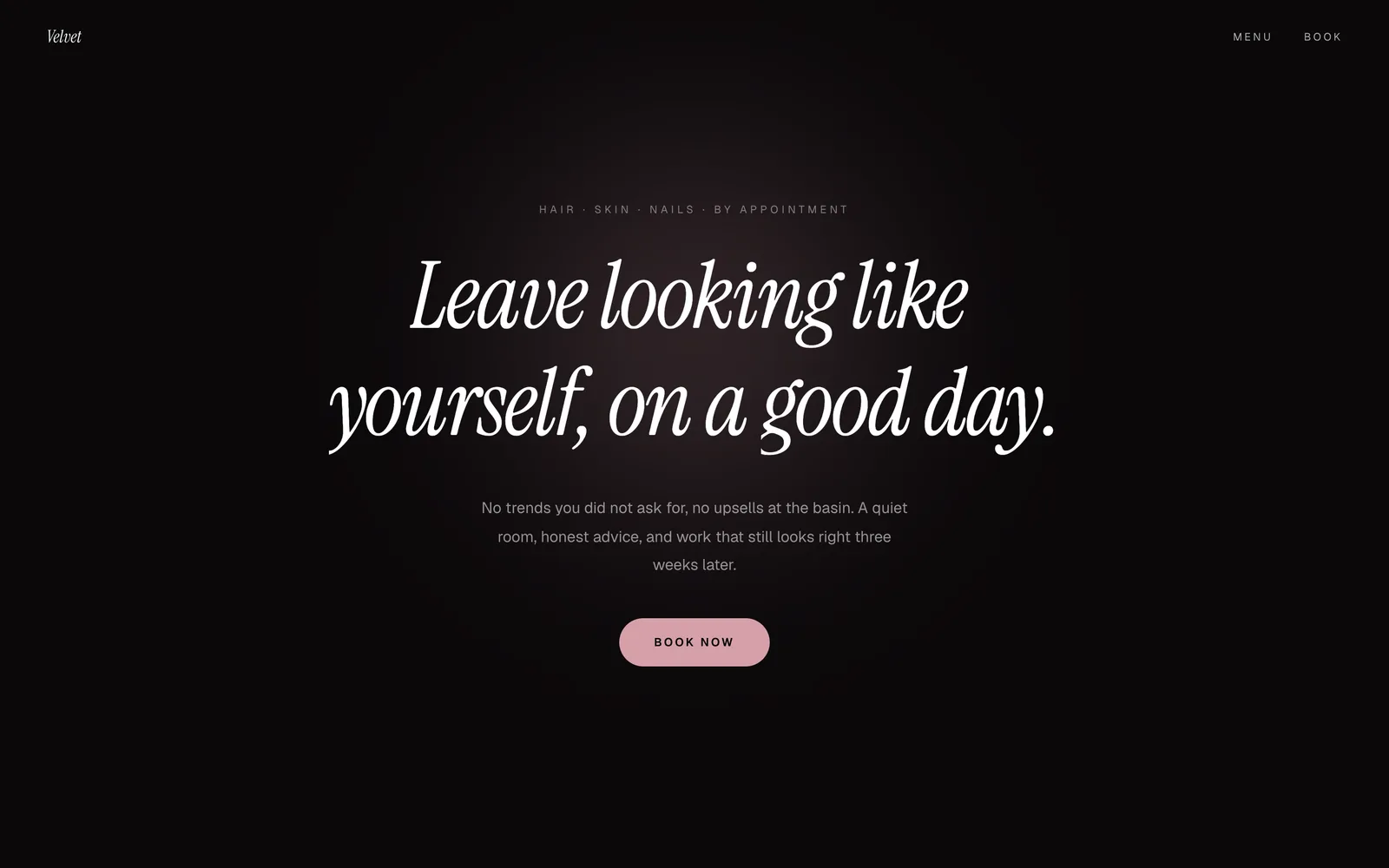
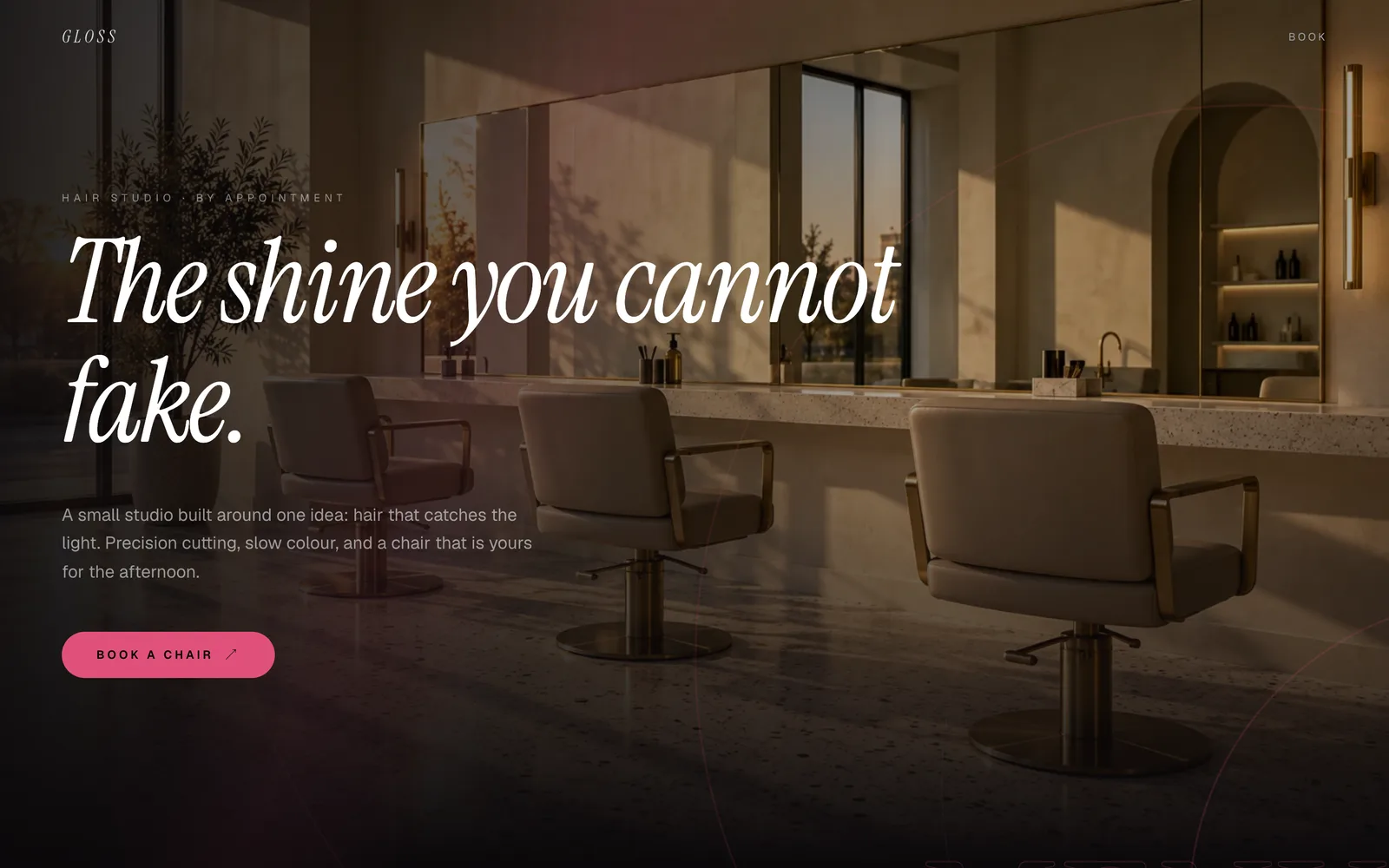
Both of these are running sites rather than pictures of sites. Open one, then put your own name, words and pictures into it: that takes under a minute and it is free for the first 7 days. From $9.99 a month to keep it, hosting included.
Questions people ask first
Should a salon website show prices?
Yes. A client comparing salons books the one that published a price. Publish per service and say what changes it, such as hair length or a colour correction.
How many photographs does a salon website need?
Enough that somebody can find the look they want: a dozen well-lit shots of real work beats three phone snapshots, and back-of-head shots matter more than most salons think.
Do I need an online booking system?
You need a booking route that works on a phone in the evening. That can be a booking system, a message link or a phone number, as long as the page says which.