Websites · dental practice websites
What the best website for a dental clinic actually does
Most dental practice websites are built the wrong way round. They open with a paragraph about a commitment to excellence and put the opening hours in a footer, when the person reading is holding a phone, has a sore tooth, and wants to know two things: can you see them, and how do they ask.
This is what the good ones do differently, and roughly what it should cost you to get one.
Who is actually reading it
Three kinds of person land on a dental website, and they want different things in the first screen. Someone in pain wants your phone number and whether you take emergencies today. Someone new to the area wants to know whether you are taking patients, where you are, and what a check-up costs. Someone considering implants or orthodontics wants evidence, credentials and a number, and they will compare you against two other practices before calling any of them.
A site that serves the first group well usually serves the other two, because all three are asking for the same thing: specific answers, quickly, without a form in the way.
The things that belong in the first screen
Not below a hero video, not behind a menu, not in a footer:
- The phone number, as a tap-to-call link, and whether it rings a person or a machine
- Opening hours by day, and what happens outside them
- The address in text a phone can hand to a map, plus a note on parking
- Whether you are accepting new patients right now
- Emergency arrangements, because that is the search somebody makes at ten at night
Put the prices on the page
The single biggest difference between practice websites that convert and ones that do not is whether a price appears anywhere. A patient who cannot find a number assumes the worst one and calls the practice that published theirs.
You do not have to publish a full fee schedule. A from price on the ten treatments people search for is enough: check-up, hygienist, white filling, extraction, crown, implant, whitening, aligners. Say what the price includes and what triggers a higher one. A practice that publishes ranges gets fewer calls and better ones, and every hour of nurse time not spent quoting on the phone is worth more than the enquiries that price transparency loses.
Make the first visit legible
Dental anxiety is the reason a lot of people have not been in four years, and it is a website problem as much as a clinical one. A short, plain description of what happens at a first appointment, how long it takes, what it costs, and whether anything is done on the day removes more friction than any amount of reassuring copy.
Photographs of your actual surgery do the same job. Stock photography of a model with unnaturally white teeth does the opposite: it tells an anxious patient nothing about the room they will be sitting in.
Booking that works with one thumb
Whatever you use, the route to it has to be one tap from the first screen and it has to work on a phone at nine in the evening, which is when most dental searches happen. If your booking system is a phone call during opening hours, say that plainly and put the number everywhere rather than hiding it behind a contact page.
One more thing worth checking: does your site tell a patient what to do if they are not registered yet. A booking button that only works for existing patients loses the new ones silently.
What it should cost
A bespoke dental practice site from an agency is usually a four-figure build plus a monthly retainer, and the practices that buy them often end up unable to change their own opening hours without raising a ticket. A template on a general builder is cheaper but arrives empty, and the work of filling it well is the part that decides whether it looks like a practice or like a template.
The third option is a finished site you fill in, which is what this catalogue is. The dental deck is a real running site: you put in your practice name, your treatments, your prices, your hours and your photographs, and it is live on a real address in under a minute. It is free for the first seven days, so you can look at your own practice on it before you decide anything, and the monthly price includes the hosting and the maintenance.
Two you can look at right now
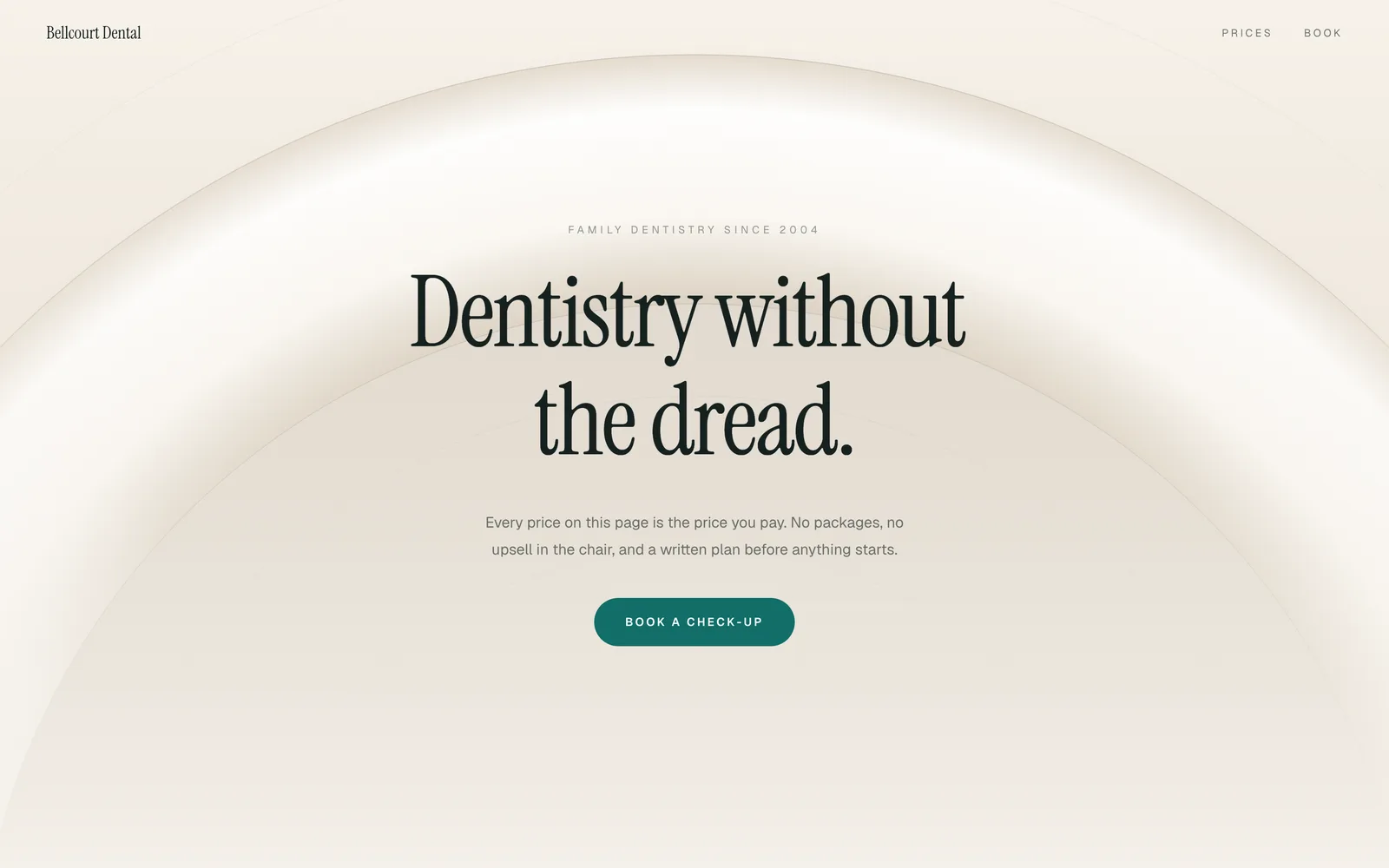
Both of these are running sites rather than pictures of sites. Open one, then put your own name, words and pictures into it: that takes under a minute and it is free for the first 7 days. From $9.99 a month to keep it, hosting included.
Questions people ask first
Should a dental practice publish its prices online?
Yes, at least a from price on the common treatments. Patients who cannot find a price assume the highest one, and the practice that publishes theirs takes the call.
How long does a dental practice website take to build?
An agency build is usually weeks. A finished deck filled in through one form is live in under a minute, because the site already exists and only the words and pictures are yours.
What should be on a dental website's home page?
The phone number, the hours, the address, whether you are taking new patients, emergency arrangements, and a from price on the treatments people search for. Everything else can be further down.