law firm / 1 finished site
Law firm websites, finished and live
Start here
From $9.99 a month, and the preview is free.
See a finished law firm siteIt opens as a real, running site you can scroll. Yours would look like it, with your own words in it.
Most law firms we look at have one of these. A template site from a legal software supplier or directory, identical to many others, with practice areas written as headings from the statute book. A site built in the 2010s with a team page of partners who have since moved, and a news section last updated years ago. A directory listing and a LinkedIn page that do the referral work, with nothing owned behind them.
And the owner says things like “A client who was referred to us still checks the website before they ring, and ours does not look like a firm worth ringing.” “Our practice areas read like the statute book and nobody outside the profession knows which one they need.” “We turn away the wrong enquiries and miss the right ones because the site does not say what we take.” “The partners are on the page but the person who actually does the work is not, and the clients ask for the partner.” “Updating anything means asking an agency, and it costs more than the change is worth.”
The senior partner or the sole practitioner. The managing partner signs; the person who actually knows what the site must say is a fee earner who has no spare hour.
Top to bottom
What your law firm site holds, in the order a visitor meets it
How we can help
Practice areas named as the client's problem (divorce, buying a house) rather than the statute, so a worried reader finds themselves.
The people who will take your call
Clients instruct a person; naming the fee earner reduces the fear of an unknown firm.
What it costs
A fixed fee or a range, or how a quote is given, wins the comparison against firms that say nothing.
What happens next
A frightened client needs to know the next step and how long a reply takes.
Regulatory information
Where the firm shows its registration and complaints process, which is both required and trust-building.
Speak to us
A phone number, an address and whether a first conversation can be remote.
Your proof, laid out
The facts a law firm is checked on
You supply each of these and we give it a clear place on the page. We never invent one for you.
- Who registers you
- Regulator and registration. The regulator's name, the firm's registration number and a link to its public record
- Cover you hold
- Professional indemnity cover. A statement that the firm holds the cover its regulator requires
- Training
- People and qualifications. Each fee earner's role, admission year and the matters they take
- Bodies you belong to
- Specialist accreditations. The specialist panels and accreditations the firm holds
- How long you have been there
- Years in practice. Year founded and the town the firm has served
- Outcomes you can state
- How a matter runs. A plain account of what happens after first contact and how long a reply takes
Our estimate, not research
One new matter is worth about $600 to $4,000 by our estimate, against the entry price of $9.99 a month, which is about 60 months of the site paid for by the smallest case.
Our estimate, not research. A routine matter such as a will or a simple conveyance is worth about $600; a contested family or employment matter can reach $4,000 or more. Fees differ widely by country and by firm, so the partner should replace both ends with the firm's own average matter.
What owners ask us first
What law firms ask us first
“Clients have to be able to log in and see their case.”
No. The site has no private client area, and for confidentiality we would still suggest case documents live in the firm's own case system. The public site explains the firm and gets the right enquiry to you.
“We cannot risk an enquiry being treated as instructing us.”
That wording is yours. The form block carries your own sentence that an enquiry does not create a retainer and that no advice is given until conflicts are checked, so the page says what you need it to.
“We are regulated, we cannot just publish anything.”
You write the claims. The site gives the regulatory details a proper place to sit, and nothing is invented for you: no made-up results or testimonials. You approve every word.
“We have a perfectly good site, it just needs updating.”
An update to an old site often costs more than a new one. A finished preview of your firm takes a minute and costs nothing to look at, and at $9.99 a month the entry price is less than the agency's minimum call-out.
questions people ask first
The catch, in full.
Do you take my type of case?
Practice areas are listed in plain words, with the fee earner for each, so you can see who deals with what.
How much will it cost?
The cost block shows fixed fees where the firm offers them and explains how a quote is given where it does not.
Does contacting you mean you act for me?
No. The page states that an enquiry does not create a retainer and that no advice is given until the firm has checked conflicts and agreed terms.
How quickly will someone reply?
The next-steps block says how soon the firm replies to an enquiry and what happens at the first conversation.
Is the firm regulated?
Yes where the firm says so: the regulator and registration details are on the page with a link to the public record.
Can we take client documents or run a secure portal?
No. Anything with client material belongs in a system built for confidentiality and retention, with the professional obligations that come with it. This is a public page: it explains what the firm does, who does it, and how an enquiry starts.
Does an enquiry form create a risk of accidental instruction?
That is why the wording around the form matters and why it is yours to write. Most firms state plainly that an enquiry does not create a retainer and that no advice is given until conflicts are checked and terms are agreed. The page gives you a place for that sentence; the sentence has to be yours.
Should we publish fees?
Publish what you can honestly commit to. Fixed fee work should carry the figure, since clients compare it directly and the firm with no number loses the comparison. For litigation or advisory work, publishing an hourly range and how an estimate is produced is enough to stop somebody assuming the worst.
We do four areas of law. Is one page enough?
For a small or mid-sized firm, usually yes: four scannable areas with the right person named under each. What one page cannot do is rank separately for each specialism in a competitive city, which needs a body of writing built over time rather than a single landing.
How much does a law firm website cost?
$9.99 a month on the One plan, which is the floor and includes the hosting. The site is free, and you pay only when you decide to keep it. There is no build fee, no setup fee and no charge for the preview.
How long does it take to get a law firm website live?
Under a minute. You pick a finished site, fill in one form with your name, your words and your pictures, and it is live on a real address straight away. There is no build queue and nothing to wait for, because the site already exists.
Can I use my own domain name?
Yes, on the Site plan and above. Every site starts on an address we give it, which works immediately and costs nothing, and a domain you own can be pointed at it afterwards without rebuilding anything.
Are these law firm websites real or mockups?
All 1 of them are running sites, not pictures of sites. Opening one shows you the same code that would serve yours, filled with our words until you replace them with your own.
Your turn
Look at a law firm site before you decide anything
From $9.99 a month, and the preview is free. The main button on your site says Enquire. Rings your reception line from a call button, and links out to your firm's own secure intake if you have one. A form that reaches your firm inbox needs a higher plan than the entry one. The page carries your firm's own no-retainer line next to it.
See a finished law firm sitenext door
Neighbouring trades
no card · a real address
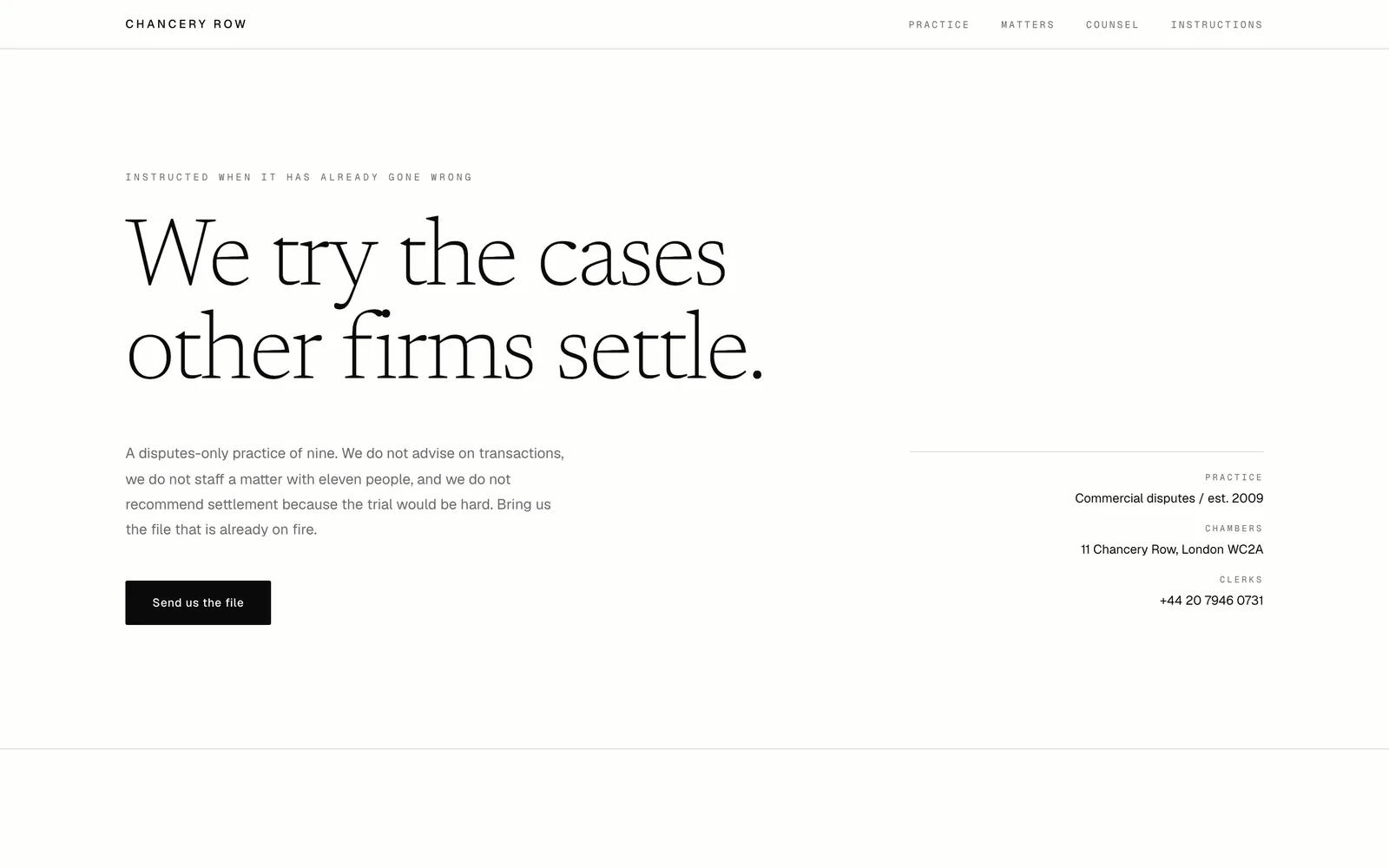
Start with Chancery Row.
Nothing here is a mockup. Each one is running on the same machine that would run yours, and putting your own name into one costs nothing and takes under a minute.
Put your name in it